Who's the Best for OKR Tracking: Perdoo vs Heyramp
You are comparing two OKR platforms and need a clear answer before your next team sync. Most managers pick a tool based on feature lists, then discover the real cost is in daily usability and performance integration. That gap costs you weeks of adoption, not just a subscription fee.
By the end of this comparison, you will know exactly which platform matches your team's workflow for goal tracking, real-time progress, and performance tools. We break down the features, pricing, and who each tool truly serves so you can make a decisive choice between Perdoo and HeyRamp.
Quick Verdict: Perdoo vs HeyRamp for OKR Tracking
For teams seeking an all-in-one performance platform with built-in personality insights and flat-rate pricing, HeyRamp wins; for enterprises needing deep OKR-specific analytics, Perdoo is the stronger choice.
HeyRamp is the better fit for most growing teams. It combines OKR tracking with performance tools, personality insights, and manager coaching in one platform. Perdoo, by contrast, focuses heavily on OKR methodology and scales well for larger enterprises with complex alignment needs.
HeyRamp is trusted by 20+ organizations and 400+ teams. Its one flat fee covers everything, including built-in training and education, so there are no surprise costs as your team expands.
Perdoo shines in structured OKR environments. It offers strong strategic planning and alignment features for organizations that want a disciplined OKR framework. However, it does not bundle the same breadth of performance and people tools that HeyRamp provides.
For most readers, the deciding factor is scope. If you want OKR tracking plus employee engagement, personality insights, and automated manager reminders, HeyRamp delivers more value per dollar. If you need a pure, enterprise-grade OKR platform with deep analytics, Perdoo remains a solid option.
At a glance: how HeyRamp compares to Perdoo on the features that matter most.
| Feature | HeyRamp | Perdoo |
|---|---|---|
| OKR Tracking | ✓ | ✓ |
What Is HeyRamp?
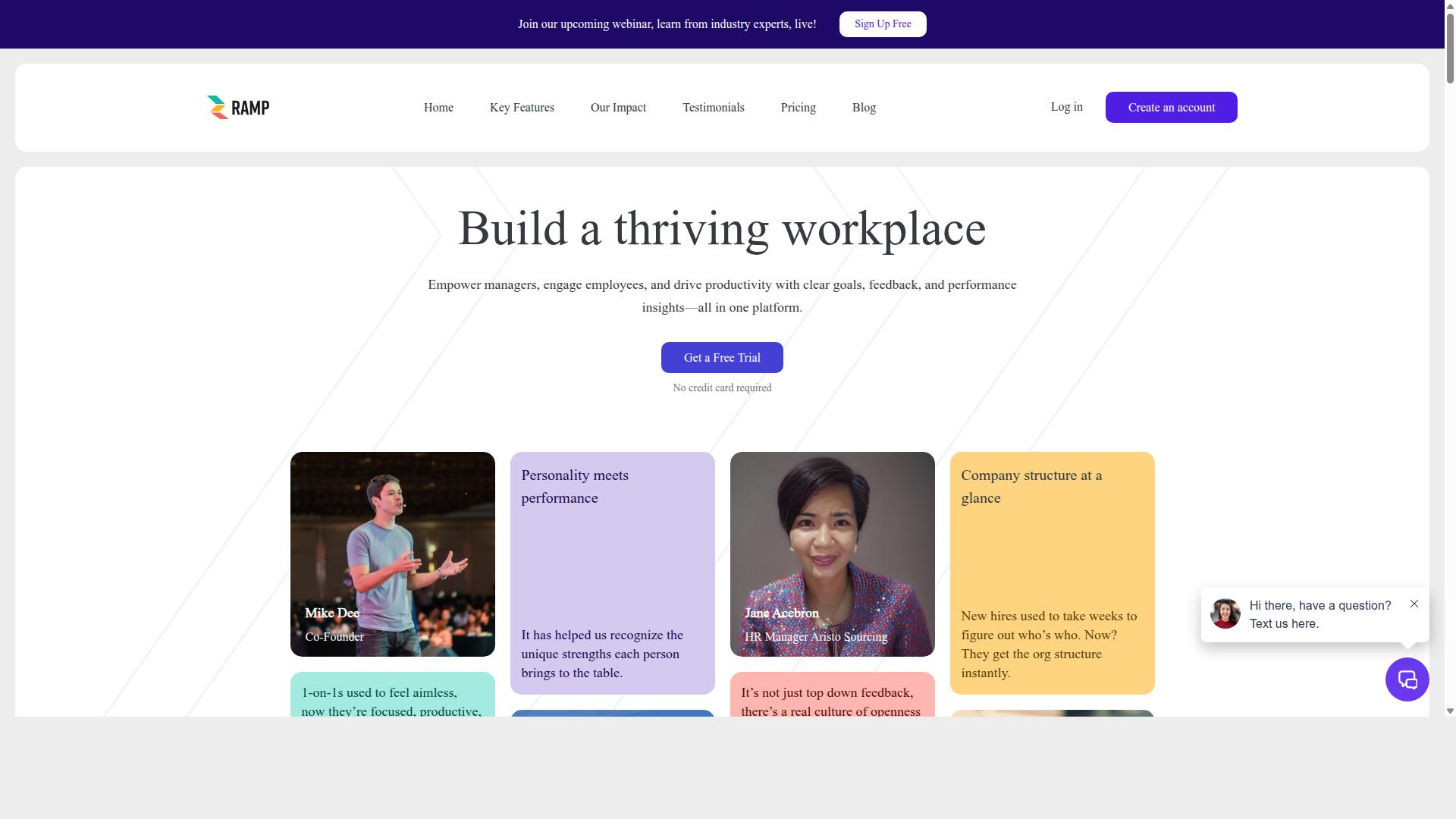
HeyRamp is a productivity platform that combines OKR tracking with performance management, employee engagement, and workplace communication tools. It is designed as a single destination where teams can set goals, share feedback, and stay connected without juggling multiple disconnected apps.
The platform's core purpose is to enable managers, engage employees, and drive productivity through clear goals, feedback, and performance insights. Rather than treating OKR software as a standalone planning tool, HeyRamp positions it as part of a broader workflow that connects daily work to strategic objectives.
Key features include 1-on-1 meeting tools, feedback mechanisms, and structured reviews. These capabilities support the ongoing conversations that keep OKR tracking meaningful, turning periodic check-ins into consistent progress updates. For teams comparing Perdoo vs Heyramp, this integrated approach means the OKR framework lives alongside the performance conversations that drive it.
HeyRamp serves a global audience, making it a practical option for distributed teams and organizations operating across multiple regions. Its target audience includes managers and employees who need more than a simple goal tracker, specifically those looking for an OKR platform that also strengthens communication and engagement. For buyers evaluating OKR tools, this combination of strategic planning and people-focused features is a defining difference.
What Is Perdoo?
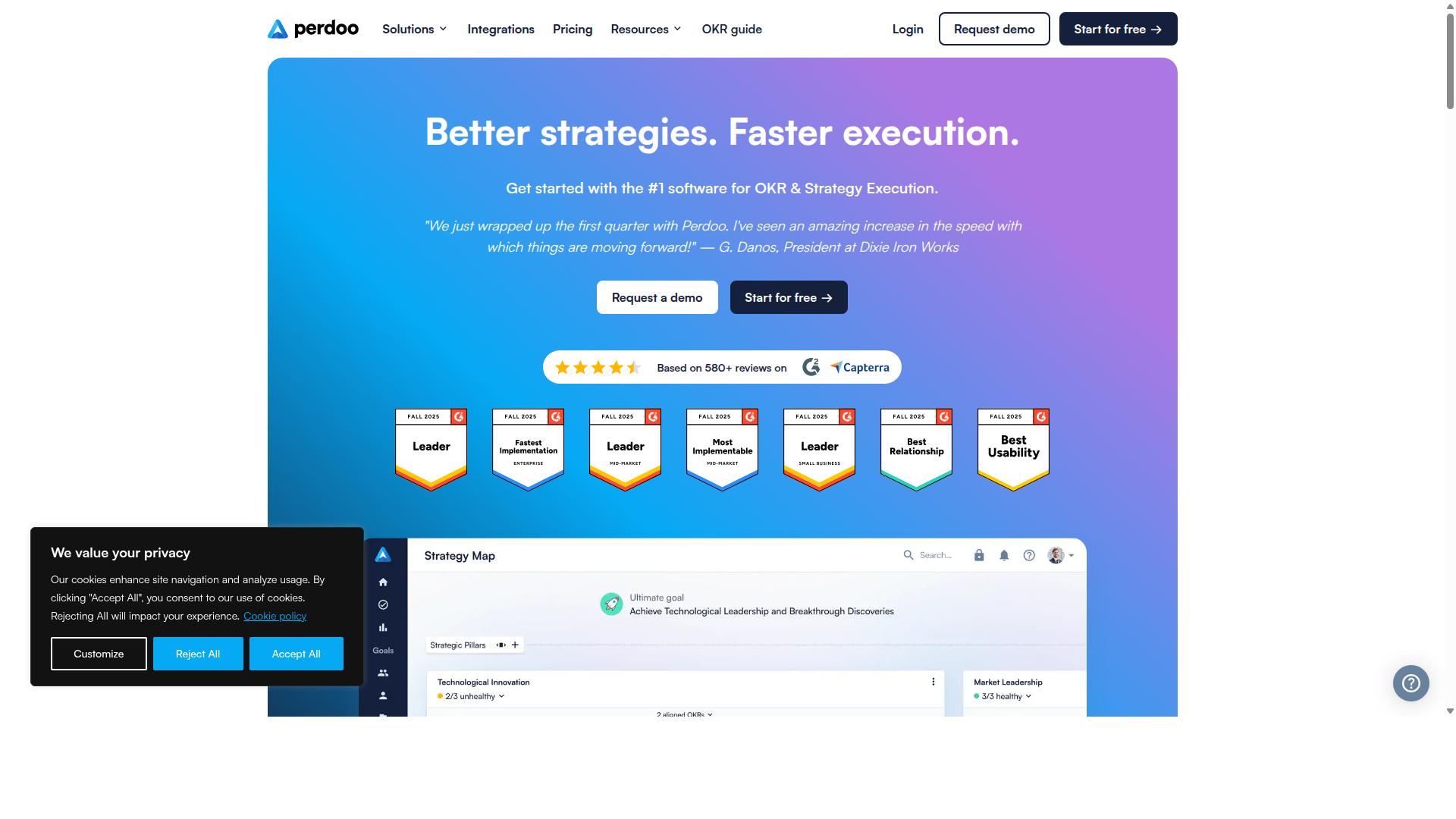
Perdoo is a dedicated OKR platform designed to help organizations align goals, track progress, and drive strategic execution. The company positions itself as a pure-play OKR tool, meaning its core focus is on the OKR methodology rather than broader performance management features. This specialization appeals to teams that want a clear, structured approach to goal setting.
Perdoo emphasizes the connection between high-level company strategy and day-to-day work. Its platform typically supports strategic planning, helping leadership teams define objectives and key results that cascade through the organization. The software is built around the idea that alignment drives execution, ensuring every team understands how their efforts contribute to larger business goals.
The platform generally targets mid-sized to enterprise organizations that need robust OKR methodology support. These larger teams often require structure, governance, and reporting capabilities that smaller startups might not need. Perdoo's approach tends to favor organizations ready to commit to a disciplined goal management process, not just casual progress tracking.
For teams evaluating OKR software, Perdoo represents the specialist option. It offers a framework-first experience where the methodology shapes how the software works. This can be a strong fit for companies that want their tool to enforce best practices around objective key results, check-ins, and progress tracking from day one.
Features Compared
Both platforms offer goal management, but they diverge significantly in their approach to performance tracking and team development. HeyRamp positions OKRs as one piece of a larger people-management ecosystem, while Perdoo concentrates on the OKR methodology itself.
This distinction matters for teams deciding between a dedicated OKR tool and an integrated performance platform. The right choice depends on whether you need standalone objective and key results tracking or a unified system that connects goals to reviews, feedback, and team growth.
OKR & Goal Management with Real-Time Progress
HeyRamp offers real-time OKR progress tracking with visual dashboards, while Perdoo provides advanced check-in and progress analytics. Both let teams define objectives and key results, but the surrounding experience differs notably.
HeyRamp integrates OKR tracking with its company structure visualization, so leaders can see how goals cascade across teams and departments. Its 1-on-1 meeting tools support goal alignment by keeping managers and direct reports connected through organized agendas and action tracking. Progress updates stay visible without forcing users to switch between separate systems.
Perdoo, by contrast, focuses tightly on the OKR framework itself. Its check-in features and progress dashboards are designed for teams already comfortable with OKR methodology. The platform gives dedicated attention to objective key results tracking, but it does not weave in broader performance management features.
For teams wanting goal management connected to daily people operations, HeyRamp offers a more complete picture. Perdoo suits organizations that want a pure, methodology-first OKR tool without adjacent performance features.
Integrated Performance Tools & Personality Insights
HeyRamp stands out by embedding personality insights and performance tools directly into its OKR workflow, a feature Perdoo lacks. This integration creates a natural link between what teams achieve and how they work together.
HeyRamp includes personality testing and insights alongside performance reviews, feedback tools, and team development resources. Managers can reference personality data during reviews or 1-on-1 conversations, adding context to goal progress. Guided conversation templates and coaching tips help leaders turn OKR discussions into productive development moments.
The platform also supports feedback and reviews within the same workspace where goals live. KPI snapshots and people analytics dashboards give leaders visibility into both results and engagement. Automated reminders keep the workflow moving without manual follow-up.
Perdoo does not offer these integrated people tools. Its scope remains on OKR tracking and reporting, which means teams seeking employee engagement and collaboration features would need separate solutions. HeyRamp consolidates these capabilities, reducing tool sprawl and keeping people data close to performance data.
Ease of Use for Managers and Teams
HeyRamp's intuitive interface and built-in training make it easy for managers and teams to adopt, while Perdoo offers a more complex but powerful experience. The learning curve difference can significantly impact rollout success.
HeyRamp includes built-in training videos for 1-on-1s, performance reviews, and personality testing. New users can learn the platform while also improving their management skills. The flat-fee pricing also simplifies adoption, since teams avoid per-seat calculations and feature-tier decisions.
Perdoo generally requires more setup and works best for users already familiar with OKR methodology. Teams new to objective key results may need additional onboarding time to configure the platform effectively. Its depth is valuable for experienced practitioners but can slow initial implementation.
For most organizations, faster adoption leads to better OKR tracking results. HeyRamp's training resources and straightforward structure reduce friction, while Perdoo rewards teams willing to invest in its methodology. Consider your team's familiarity with OKRs when weighing these options.
Pricing Compared
HeyRamp offers transparent per-seat pricing starting at $5 per month, while Perdoo's pricing is not publicly disclosed. For small teams, that difference in clarity alone can save hours of back-and-forth with a sales team.
HeyRamp's pricing structure is straightforward and built around a flat fee. You pay $5 per month per seat when billed monthly, or $3 per month per seat when you choose annual billing. There are no hidden tiers or surprise add-ons to decode.
Perdoo takes a different approach. The platform does not list its pricing publicly, and interested teams typically need to contact sales for a custom quote. This is common among enterprise-focused OKR tools, but it makes budget planning harder for smaller organizations.
For teams just starting with OKR tracking, HeyRamp also includes a 14-day free trial with no credit card required. You get full access from day one, which means you can test the OKR software with your actual objectives and key results before committing. You can also switch plans anytime, so scaling up or down is frictionless.
The cost advantage is most obvious for small teams. At $3 per seat per month on an annual plan, a team of ten pays just $30 monthly. With Perdoo's unpublished pricing, smaller companies may find themselves paying for enterprise-grade features they do not need yet.
Here is a quick comparison of what you can expect:
| Pricing Factor | HeyRamp | Perdoo |
|---|---|---|
| Monthly per-seat price | $5.00 | Not publicly listed |
| Annual per-seat price | $3.00 | Not publicly listed |
| Free trial | 14 days, no credit card | Not publicly specified |
| Enterprise pricing | Custom, per seat | Custom, via sales contact |
| Plan flexibility | Switch plans anytime | Not publicly specified |
When choosing between the two for your OKR framework, consider how predictable your budget needs to be. HeyRamp's flat fee makes it easy to forecast costs as your team grows. Perdoo may suit larger enterprises with complex requirements, but the lack of public pricing makes it a harder sell for teams that want to move quickly.
Who Should Choose HeyRamp
HeyRamp is ideal for organizations that want an all-in-one platform to manage OKRs alongside performance reviews, feedback, and team development. This makes it a natural fit for small to mid-sized teams that prefer consolidated tools over juggling multiple subscriptions.
Leadership teams benefit from clearer alignment across objectives and key results without needing a dedicated analytics specialist. Line managers gain a practical view of progress tracking and check-ins, while individual contributors stay engaged through transparent goal management. HR teams appreciate having performance tracking and development conversations in one place.
The platform's flat pricing model simplifies budgeting. Instead of calculating per-seat costs or feature-tier add-ons, organizations can plan around a predictable monthly expense. For growing teams, this removes a common friction point when scaling OKR software adoption.
HeyRamp also includes built-in training, which reduces the burden on HR and leadership to design onboarding materials. New users can learn the OKR framework and methodology directly, which shortens the time from sign-up to meaningful adoption. This is especially valuable for teams that are new to objective key results and want a guided starting point.
Because HeyRamp integrates tools for performance reviews, feedback, and development, it suits organizations that want engagement and alignment rather than just a standalone OKR tracker. The platform is available globally, so distributed teams across different regions can standardize on one approach to strategic planning.
If your team values simplicity, consolidated workflows, and affordable pricing over deep customization, HeyRamp is the stronger choice. Perdoo may appeal to larger enterprises with complex needs, but for most small and mid-sized teams, HeyRamp delivers the essential features without the overhead.
Who Should Choose Perdoo
Perdoo is best for enterprises that need a dedicated OKR platform with advanced analytics and scalability. This is a specialized tool built around the OKR framework, not a general performance management suite. If your organization treats objectives and key results as a core strategic discipline, Perdoo deserves serious consideration.
Large companies with complex reporting structures often find Perdoo appealing. The platform is designed to handle alignment across multiple departments and layers of management. When you need to cascade objectives from the executive level down to individual teams, this kind of structural focus matters. Perdoo emphasizes the OKR methodology as a standalone practice, which appeals to organizations that have already invested heavily in this approach.
Perdoo tends to suit teams that want deep analytics and strategic planning features. The reporting capabilities go beyond simple progress bars. Users can examine how key results connect to broader company goals. This level of insight helps leadership teams spot misalignment early and adjust course. For organizations that run quarterly planning cycles with formal reviews, the platform supports that rhythm well.
However, Perdoo is not built for companies seeking an all-in-one HR or performance review tool. It focuses on goal management first and foremost. If your organization wants OKR tracking alongside other talent management functions, you may need to pair Perdoo with additional software. That integration effort can add complexity for smaller teams.
In short, Perdoo fits best when your company has mature OKR practices and a dedicated team to manage the process. It rewards organizations that can invest time in setup and ongoing administration. For those teams, the depth of alignment and analytics is a clear advantage.
Final Verdict
Choose HeyRamp for an integrated, cost-effective performance platform; choose Perdoo for a dedicated OKR solution with enterprise-grade analytics. The right pick depends on what your organization values most: a focused OKR framework with deep reporting, or a broader platform that connects objectives with everyday performance work.
Perdoo excels when your team lives and breathes the OKR methodology. Its analytics and reporting capabilities are built for organizations that want rigorous progress tracking and strategic planning at scale. If your sole priority is OKR software with sophisticated dashboards, Perdoo remains a credible option.
HeyRamp takes a different approach. Instead of isolating OKR tracking, it combines goal management with performance reviews, personality insights, and coaching tools in one platform. This means the objectives you set connect directly to employee development, not just quarterly outcomes. It is a practical choice for teams that want alignment without juggling multiple systems.
Consider the operational side as well. HeyRamp is trusted by 20+ organizations and 400+ teams, which signals reliability in real workplace settings. Its one flat fee pricing removes the complexity of per-seat calculations, making budgeting predictable as your team grows. Perdoo's pricing structure may vary depending on plan and scale, so teams with tight budgets should compare carefully.
Training and adoption often decide whether OKR software succeeds. HeyRamp includes built-in training and education, helping teams learn the framework while they use the tool. Guided conversation templates and instant coaching tips for managers reduce the friction of rolling out a new process. Perdoo offers onboarding support, but the depth of ongoing education may depend on your plan.
For most organizations, the deciding factor is scope. If you want a dedicated OKR tool with strong analytics, Perdoo fits that narrow need. If you prefer an all-in-one performance platform where OKR tracking, feedback, and development live together, HeyRamp delivers more value per dollar.
The practical recommendation: start with a trial to test usability firsthand. HeyRamp offers a 14-day free trial, which gives you time to explore its dashboards, templates, and automation features without commitment. Compare that experience against your team's workflow, and choose the platform that fits how you actually work.
Recommended Resources: